
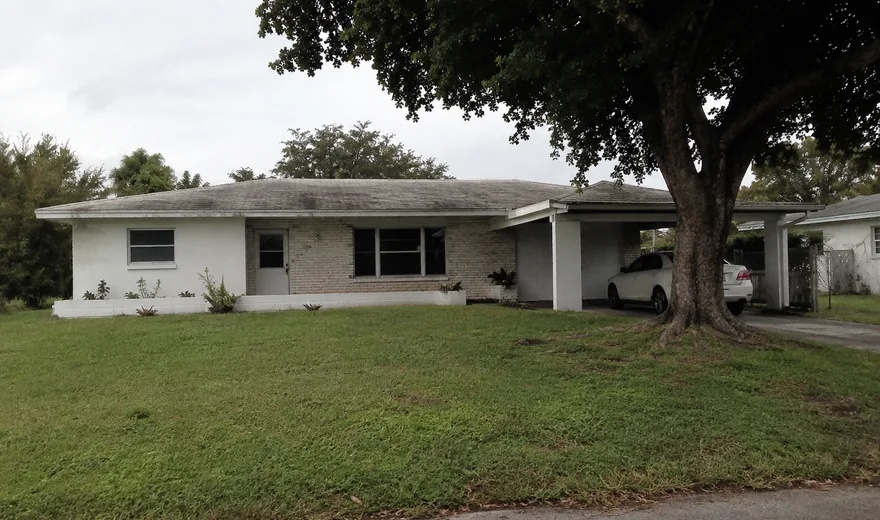
Margate has more flat roof per house than anywhere else we work. The 1960s and early 1970s building boom that produced Oriole Estates, Calypso Cove and the streets off Royal Palm Boulevard favoured shallow-pitch and genuinely flat roofs, usually finished as gravel-surfaced built-up. Sixty years later most of them are on their second layer, and a third is not allowed.
Why does the gravel matter?
A gravel-surfaced built-up roof cannot be coated or recovered directly, so the gravel has to come off and the surface has to be sound and dry before anything new goes on. Where two layers already exist the code requires a full tear-off regardless of condition. That tear-off is $2 to $4 a square foot on top of the new system, and a Margate quote that does not contain it has either not been up on the roof or is planning to discover it later.
| Approach | Cost for 900 sq ft | Life | When it applies |
|---|---|---|---|
| Silicone restoration over a sound single layer | $3,600 to $6,300 | 10 to 15 years added | Core cuts come back dry |
| Tear-off and two-ply modified bitumen | $9,000 to $14,400 | 15 to 20 years | Two existing layers, or wet insulation |
| Tear-off and 60 mil TPO | $9,000 to $15,300 | 15 to 25 years | Larger open areas, reflectivity wanted |
| Tapered insulation to kill ponding | add $2,700 to $7,200 | Life of the roof | Water standing after 48 hours |
What is the rest of the Margate housing stock like?
Single-storey concrete block, small footprints, wide streets and mature trees, with pockets of 1980s tile out toward the Coconut Creek line. Oriole Estates in particular was built fast and cheap and has been re-roofed piecemeal ever since, so it is common to open one of these roofs and find three different eras of workmanship on one house. The State Road 7 corridor is a different animal again: strip retail and small industrial with large low-slope roofs that mostly need commercial attention and a maintenance file rather than replacement.
On the pitched sections, architectural shingle is the sensible default here. Margate is inland enough that the coastal fastener upgrade does not apply, which takes several hundred dollars off a job compared with the same house near the water, and the housing values do not usually justify tile where tile was not already there.
How do you know if a Margate flat roof can be coated?
Core cuts. A small square of the existing system is cut out and examined for trapped moisture, and the insulation underneath is checked for saturation. Dry cores mean a silicone restoration is a legitimate option at roughly half the cost of a rebuild. Wet cores mean coating would seal water against the deck, and the honest answer is a tear-off. Anybody proposing a coating on a sixty-year-old Margate roof without cutting cores is guessing with several thousand dollars of your money. Full detail is on the flat and low-slope page.
Are Margate permits different to Pompano Beach?
The code is identical, since both are Broward County and both sit inside the High-Velocity Hurricane Zone, so the product approvals, the deck re-nailing and the secondary water barrier are all the same. The fee arithmetic is set by each city separately, though, and it varies more than most homeowners expect across this county. The permit fee comparison sets the local cities side by side.
How long does it take you to reach Margate?
Fourteen minutes west, out Copans and up Banks Road. Flat roof assessments in Margate normally get booked within a couple of days, and the measuring of low spots is part of the free look rather than a paid survey.
Nearby: Coconut Creek roofing, roofing in Coral Springs and roofing for Oakland Park properties. Call (954) 697-4046.
Margate flat roof holding water?
Ponding on a Margate low-slope roof is usually fixable without a full rebuild. Fourteen minutes from the yard, and the look is free.
- 5-Star Rated
- Licensed & Insured
- Written, Itemised Quotes
Call before 4pm and a person picks up, not an answering service. Same-day callback on every voicemail, seven days a week.