
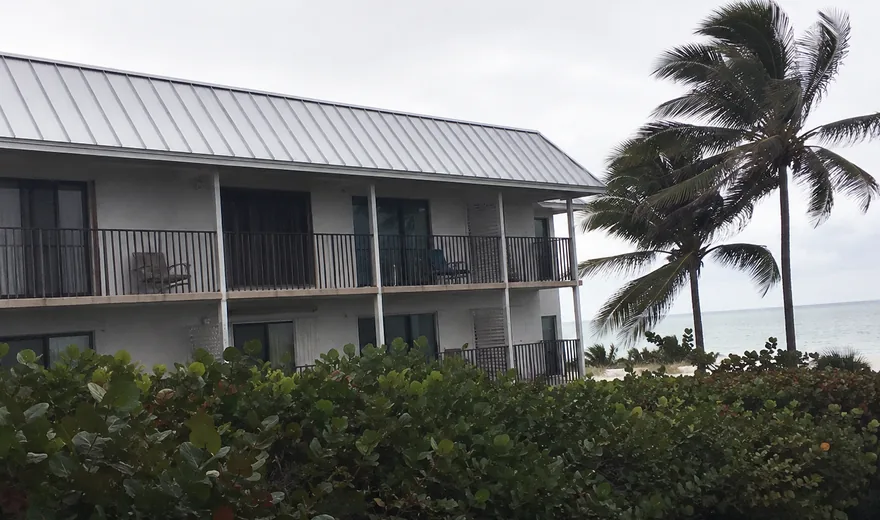
Rust streaks running down from the screw heads is the signature failure on a Lauderdale-by-the-Sea roof, and it is a specification problem rather than a maintenance one. This is a town roughly half a mile wide with the Atlantic on one side and the Intracoastal on the other. Every single property sits inside the band where salt aerosol attacks fixings, and standard electro-galvanised fasteners have no business on any roof here.
What should a coastal roof here actually be built from?
Stainless steel fasteners, aluminium flashings, and aluminium rather than coated steel wherever metal panels are used. Salt does not care what the covering is made of; it goes after the fixings, and a roof full of corroded screw heads is leaking at fifty points before the panel or tile shows any wear at all. The premium over an inland specification runs $400 to $1,600 on a typical house and considerably more on a metal roof, and it is the difference between a forty-year roof and a twenty-year one.
| Component | Inland Broward | Lauderdale-by-the-Sea | Added cost |
|---|---|---|---|
| Fasteners | Hot-dipped galvanised | Stainless steel | $300 to $900 |
| Flashings and edge metal | Galvanised steel | Aluminium | $200 to $700 |
| Metal panel substrate | Galvalume steel | Aluminium | $3,000 to $6,000 |
| Vent and stack components | Standard | Marine grade or lead | $150 to $450 |
What is the property mix?
A dense strip of low-rise condominium, small hotels and older single-family running either side of El Mar Drive and Commercial Boulevard, with the Terra Mar and Bel Air sections carrying most of the detached housing. A lot of it dates from the 1950s and 1960s, much of it has flat or very low-slope roofs, and a fair share of the buildings are three or four storeys with rooftop mechanical plant. Anglin's Pier and the beach frontage bring salt and wind exposure that would be unusual anywhere else in our area and are simply the baseline here.
Because so much of the town is multi-family, roofing decisions tend to be association decisions, with the same requirements a Hillsboro Beach board has: a written scope, quantities, phasing that keeps every unit dry, and photographs the members can follow. On the detached side, aluminium standing seam is more common here than anywhere else we work, for the obvious reason.
Does the exposure change the wind design too?
Yes. An oceanfront property with open water upwind sits in a harsher exposure category than an identical house four streets inland with buildings and trees around it, and the uplift pressures the roof assembly has to resist go up accordingly. Combined with the High-Velocity Hurricane Zone requirements that apply across Broward, that means more fasteners, tighter perimeter and corner zones, and product approvals that cover the higher pressures. It is genuinely a different roof, not the same roof with better screws.
How often should a coastal roof be checked?
Twice a year, and one of those should be immediately after the season rather than in the spring. Salt accumulation on fixings and flashings is cumulative and visible long before it leaks, so a maintenance visit that catches early corrosion is the cheapest intervention available on a beachfront roof. Rinse-down of exposed metal is part of that visit here, which is not something we would bother with in Margate.
How far away are you?
Thirteen minutes southeast, down A1A or Federal. Storm and active-leak calls in this town get priority in the season because a compromised roof this exposed deteriorates faster than an inland one.
Nearby coverage: Oakland Park roofing and roofing in Lighthouse Point. Call (954) 697-4046.
Oceanfront roof with rust streaks showing?
Weeping fastener heads on a coastal roof are a specification problem, not a maintenance one. Call and we will tell you which.
- 5-Star Rated
- Licensed & Insured
- Written, Itemised Quotes
Call before 4pm and a person picks up, not an answering service. Same-day callback on every voicemail, seven days a week.