
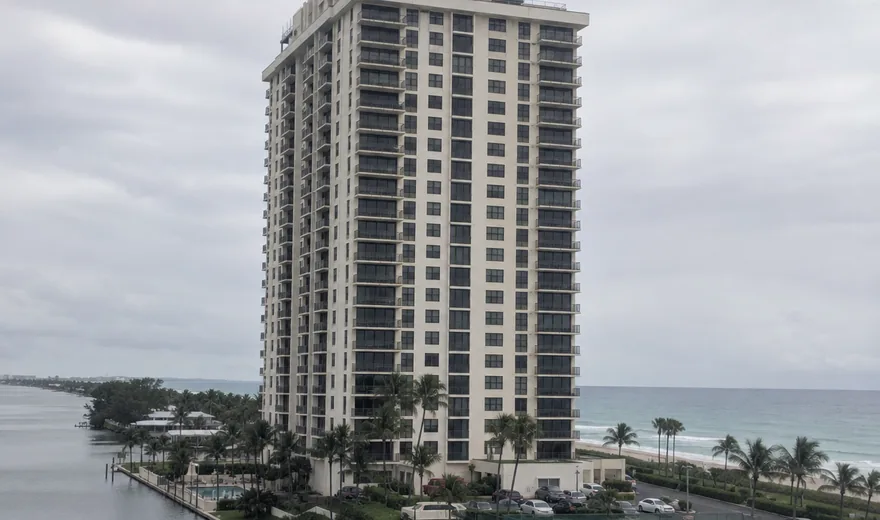
Hillsboro Beach is three and a bit miles of barrier island with the ocean on one side, the Intracoastal on the other, and almost nothing in between except condominium towers and a run of oceanfront estates along the Hillsboro Mile. Roofing here is a board decision far more often than a homeowner one, and it arrives attached to Broward's structural recertification regime rather than as a standalone job.
Why does recertification drive roof work on this island?
Multi-storey residential buildings in Broward fall under the county's building safety inspection regime, and roof condition feeds directly into the report an engineer or architect submits. Once a building is inside that cycle, the roof stops being a maintenance item that can be deferred another budget year and becomes a documented deficiency with a deadline. Pompano Beach, as a comparison point one town south, charges $350 per building simply to submit the safety report, before any remediation is priced. Boards that get ahead of it with dated photographs, core sample results and a written scope spend materially less than boards that respond to a notice.
| Document | Why the board needs it | Lead time |
|---|---|---|
| Photographic condition survey | Members can see what they are voting on | 1 week |
| Core cut results | Decides coating versus tear-off, and it is the biggest cost fork | 1 to 2 weeks |
| Written scope with quantities | Allows three genuinely comparable bids | 1 to 2 weeks |
| Phasing plan | No unit left open overnight, elevator and access impact | With the scope |
| Reserve study alignment | Funding and any special assessment | Board and management |
What are the roofs actually made of?
Two quite different populations. The towers carry large low-slope roofs, usually modified bitumen or single ply, heavily populated with mechanical plant, cooling towers and access hatches, where the field of the roof is easy and the detailing around fifty penetrations is the job. The estate properties along the Hillsboro Mile are barrel tile and flat combinations on substantial houses, frequently with roof terraces and drainage arrangements more complicated than anything on the mainland. Both sit in the harshest exposure category we work in.
Salt specification is non-negotiable on this island. Stainless fixings, aluminium flashings, marine-grade components at every penetration, and aluminium rather than coated steel wherever panels are used. The same rules apply down the coast, and the cost premium is broadly identical.
Can you work around residents and access restrictions?
Yes, and on a barrier island that is most of the planning. A1A is the only road, deliveries have to be scheduled rather than assumed, crane and dumpster placement needs permission and sometimes a lane closure, and on a tower the material goes up by hoist rather than by ladder. All of that is worked out before mobilisation and priced into the number, because discovering it during week one is how a phased job turns into a three-month one.
What about single-family properties on the Mile?
Those get treated as the substantial private jobs they are: tile on the pitched sections, low-slope systems on the terraces and flat areas, and a great deal of attention to drainage, because a roof terrace that ponds over a habitable room is a very expensive problem. Twice-yearly maintenance is standard on these properties rather than optional.
How long does it take you to get there?
Eleven minutes northeast up A1A. Close enough to attend a board meeting in person, which for association work is worth more than any amount of documentation.
Adjacent coverage: Lighthouse Point roofing and roofing in Deerfield Beach. Call (954) 697-4046.
Board asking for roof options and numbers?
We write scopes boards can put out to three bidders, with photographs. Eleven minutes up A1A from the yard.
- 5-Star Rated
- Licensed & Insured
- Written, Itemised Quotes
Call before 4pm and a person picks up, not an answering service. Same-day callback on every voicemail, seven days a week.